2012年6月18日星期一

Way to Use a Sheet Metal Roll-Forming Machine

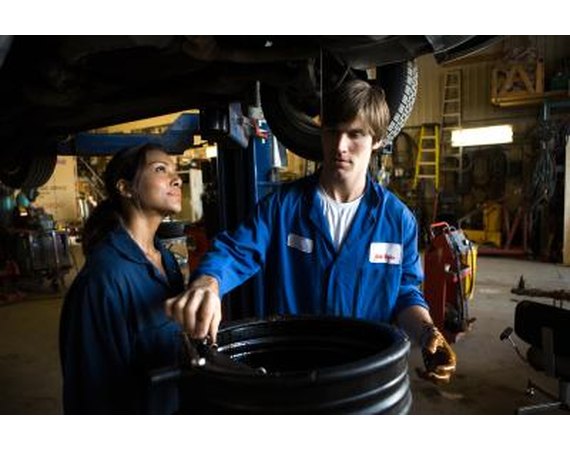
Sheet metal roll-forming equipment uses a series of rolls to form complex seams and flanges on lighter gauge sheet metal. The majority of roll-forming machines are geared toward fabricating duct and duct connectors for the HVAC industry. Properly operating a roll-forming machine goes beyond how to turn the machine on; it also includes daily inspections, oiling and cleaning to ensure that the rolls operate smoothly, that the guards are in place and that the metal does not jam, which can cause an injury.
Instructions
 

1 Put on your safety glasses.
2 Place the socket that matches the guard bolts onto the 3/8-inch drive ratchet and loosen the nuts that hold the guard onto the top of the metal roll forming machine.
3 Lift the guard up to remove it from the top of the roll former.
4 Blow out the area between the rolls with the air hose to remove metal shavings and other debris from the series of rolls, and spray the rolls with tool oil to add lubrication and prevent corrosion from forming on the face of the rolls.
5 Slide the guard back over the studs and tighten the nuts with the ratchet to secure the guard to the roll-forming machine.
6 Inspect the installed guard to ensure that no part of the guard falls into the feed area of the roof panel roll forming machine and that the starting guide located on the feeder bed, in front of the guard, is not damaged.
7 Turn on the roll-forming machine by depressing the green start button.
8 Rest the side of the metal that is going to be roll formed against the starting guide and slide the metal toward the guide.
9 Support the metal sheet as it is grabbed by the wall panel roll forming machine, works its way down through the series of rolls and is ejected from the far side of the roll-forming machine.
10 Inspect the finished rolled edge to ensure that the clearances are correct. If you notice that the seam is malformed or jammed tight, adjust the rolls according to the operating manual and run another piece of sheet metal through the roll-forming machine.

Make Small Powder Coating Equipment

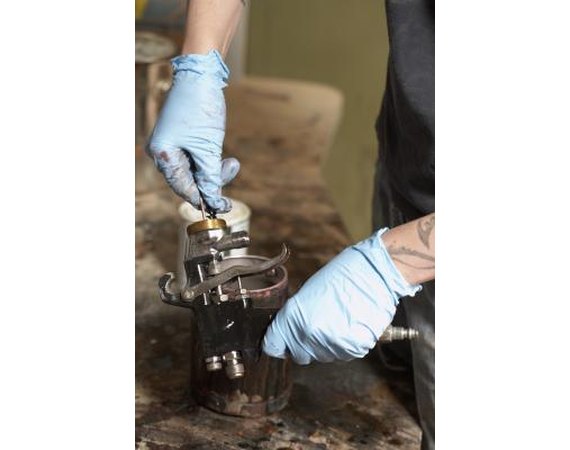
Airbrush guns blow a fine, controlled mist of paint. One piece of home powder coating equipment that a powder coating hobbyist may want to make is a paint gun. The device is similar to an airbrush gun, but the particles of powdered paint are charged with an ionizer as they leave the gun so they cling to objects.
Instructions
 
1 Take the cover off the case of the ionizer and find the metal part(s) that ionize the air. If the ionizer has a fan, they will surround the fan's airflow path.
2 Attach the ionizer to the handle of the airbrush gun using electrical tape. Ensure that you can turn the ionizer on and off easily.
3 Strip the insulation from each end of the wires. Attach one end of each wire to the ionizer. Tape the wires down along the airbrush gun, then cut them long enough to reach the front of the gun.
4 Bend the wires around the nozzle of the airbrush gun so the paint that comes out passes through the ionizing field created by the wires.
5 Load the airbrush gun's paint reservoir with powdered paint that suits the powder coating application you need.
Tips & Warnings
Wear a breathing mask when operating the powder paint gun

How Does a Diesel Pump Operate?

What is a Diesel Pump?
A diesel pump's full name is a diesel injection pump, and like the name suggests, is responsible for injecting fuel into the firing cylinders of diesel engines. It is important to remember that, unlike gasoline-powered engines, diesel engines do not use spark plugs to ignite the fuel in the firing cylinders. They rely entirely on the high compression pressure of the fuel in the cylinder to result in combustion. As a result, Zongshen diesel pumps are extremely important and must be built tough to produce the compression rates of up to 15,000 psi necessary for the engine's functioning.
Distributor Injection Pumps
 
Distributor diesel injection pumps are also called rotary injection pumps. They are comprised of a hollow cylinder called a rotor as it sits on a cam which connects to the ports of the distributor head. The rotor sits between the firing cylinders in the China power engine block, and has a small hole in one side. Unlike a gas engine, this distributor is more similar to a carburetor in that it pushes blasts of fuel through to the rotor in time with the rise and fall of the engine's pistons. Sitting on a cam as it is, the rotor turns toward the firing cylinder when it's about to fire, aligns its hole with the port on the side of the cylinder, and sprays in the fuel just in time for the combustion, before turning again toward the next cylinder to repeat the process.
Inline Injection Pumps
Inline diesel injection pumps were among the first design to be created, and are generally considered very effective. They involve a layout similar to that of the actual engine. A cylinder of the pump sits atop each one of the engine's firing cylinders. They even have a set of pistons like the engine, but in the high lift pump manufacturers the pistons point downward while the engine's pistons point upward. A rotating cam sits atop of the length of the pump's cylinders and connects to the engine's serpentine belt. A fuel line connects into the sides of each of the pump's cylinders. When the engine starts, the cam atop the pump turns, forcing one piston down after another in the exact same sequence as the pistons in the engine's firing cylinders. Each pump piston forces fuel into the engine in a highly-concentrated spray. This combined with the engine's air intake design creates the necessary compression in the firing cylinders for combustion. When the pump pistons draw back, simple suction pulls more fuel from the lines into the pump's cylinders.

2012年6月13日星期三

Way to Measure Machine Parts

There are many ways to measure parts in a machining environment, including calipers, micrometers and indicators. By calibrating them often to ensure accurate readings, you can compare finished parts to the specifications noted on prints.
Instructions
 
1 Use a dial caliper to measure the outer diameter of Gaogel machining part . Open the caliper with the thumb wheel on the left side, and lightly close the blades on each side of the area to be measured. This will give you the outer dimensions. Look at the slide on the left blade, this will give you the first part of the dimension, then add the amount on the dial to get the total dimension. If the blade is past the large 2, slightly past the smaller 5 and the dial is pointing to 10, the dimension is 2.51".
2 Find an inner diameter measurement with a digital caliper. Insert the small blades on the top of the caliper into an inner diameter, and slowly move the thumb wheel to the right to expand the blades. When they hit each far side the measurement window will tell you the dimension, either in millimeters or inches.
3 Use a micrometer to measure outer diameters of small China stamping part. These measuring instruments are very accurate and come in many sizes. Most sets have micrometers to measure from 1 inch all the way up to 3 inches. Place the object between the anvil and the spindle, and twist the thimble until the spindle touches the other side of the diameter you are measuring. The dimension on the sleeve is added to the dimension noted on the thimble to get your outer diameter size.
4 Use a depth micrometer to measure the depth of flat-bottom holes and slots. Place the reference plane on the top surface, and twist the spindle until the bottom of the measuring rod touches the bottom surface to be measured. Read the dimensions like that of an outer diameter micrometer; add the sleeve dimension to the spindle dimension to get your reading.
5 Use a dial indicator to measure small precision parts. Set the indicator on a flat surface and lower to just above the part to be measured. Push the indicator's point onto the highest area of the turning part manufacturer, and re-zero the indicator by turning the bezel and setting this point as your new zero. Move the part back and forth to make sure that the highest point is indicated at that new zero. Take any new parts and slide them under the indicator to make sure that they are of the same size.
Tips & Warnings
Calibrate your measuring instruments often by measuring precision blocks to check them for accuracy. If there are any problems, send them back to the manufacturer for repair.

Learn to Change the Oil in a Gas Generator

If you live in an area with frequent power outages, or perhaps your home is subject to harsh storm conditions, you may want to invest in a gasoline powered generator to power your home. In order to keep your generator running smoothly, you'll need to make sure that you maintain it properly. That includes changing the oil at manufacturer-suggested intervals. You can change the oil in your generator yourself in just a few minutes with basic tools. You should change the oil in your new generator after the first 25 hours of use, and then every 100 hours (or three months) after that.
Instructions
 
1 Drain the used oil from the perkins generator set. Using an adjustable wrench, loosen the oil drain plug on the underside of the engine and drain the used oil into a drain pan. When all the oil is drained, replace the drain plug.
2 Remove the used oil filter. Unscrew the plastic oil filter (located on the underside of the engine, near the drain plug) and install a new filter. There may be an additional bolt that holds the filter in place. Remove this with an adjustable wrench.
3 Fill the portable gasoline generator factory with clean oil. Remove the dipstick from the filler tube. The dipstick is a black plastic knob that has a picture of an oil can printed on it. Slowly pour the new oil in the filler tube, and allow it to settle in the bottom of the oil pan.
4 Check the oil level. As you are filling the oil pan, use the dipstick to check the oil level. Allow the oil to settle in the pan for a few minutes. Clean off the dipstick with a rag and dip it in the filler tube. There are markings at the bottom of the dipstick indicating the oil level in the engine. The oil level is where the wet oil leaves a trace on the stick. Make sure that the oil is all the way up to the "full" mark, but not past it.
5 Start the generator for a few minutes, then shut if off and allow the oil to settle again. Re-check the oil levels and add more if needed.
6 Recycle the used oil. Pour the old oil from the drain pan into an empty milk jug and take the oil to your local recycling center or a oil change facility for proper disposal and recycling.

How Does a Diesel Engine Block Heater Operate

Location
Normally, block heaters are installed in one of the factory freeze-plug locations. This allows them to most effectively heat both the coolant and the oil at the same time. They run off normal house 110V AC outlets, and many times the plug for the block heater can be seen hanging out of the grille. These heaters are popular in the Midwest, where winter temperatures regularly dip low enough to freeze the fluids in a vehicle's Bronco diesel engine. It is recommended to have a qualified shop install your block heater, but if you're an experienced do-it-yourselfer who knows your way around an engine compartment, you shouldn't run into too many problems.
 
Time Frame
Typically, people plug their engine block heaters in before bed and let them run until the morning, when they have to start the vehicles again. Studies have shown, however, that four hours of block-heating time is optimal and very little good is done after that point. Therefore, you can conserve power and save money by not having your Tiger gasoline engine block heaters going for eight hours at a time. A standard timer switch can be implemented to aid this process.
Effects
Cold oil and coolant is thick and viscous, and it is difficult for the engine to circulate such fluids. A block warmer keeps these components at a higher temperature, which makes the car start and run better in the morning. It also helps the professional gasoline generator engine reach operating temperature much faster, which improves power and economy, allows the heater inside the passenger compartment to be more effective, and provides proper lubrication to the engine and all its parts.
Alternatives
Some companies offer heating blankets that span the entire engine bay and keep everything warmer on cold nights. Some people recommend battery warmers, which keeps only the battery warm but aids in cold starting power. Aftermarket heaters that temporarily attach to the oil pan are used to heat the oil, giving better lubrication during cold starts.

2012年6月5日星期二

Process of Magnetic Separation


The mining industry often uses iron magnetic separator to recover metals from the surrounding rock. Magnetic separation is an industrial process that uses a magnetic field to separate magnetic materials from non-magnetic ones. Iron, for example is highly magnetic; magnetic separation is sometimes used to separate iron ore from surrounding silicate rock. Magnetic separation can also be used to separate ferrous materials, or materials that contain iron, from industrial waste streams before they can contaminate water supplies.
Magnetic fields
When any mineral is exposed to a magnetic field, it is either drawn by the field or not. Particles that are drawn to the field are called magnetic. There are different sorts of China low intensity cleaning Magnetic separator, but the most common is the drum. Essentially a stream of material is dropped onto the outside of a magnetic drum. Non-magnetic or weakly magnetic particles bounce or fall off of the drum. The remaining magnetic particles stick to it until they are scraped off.
Impact grinding
Sometimes, after passing around the first drum, the remaining material hits what is called an impact grinder or impact mill. The impact grinder contains a rapidly spinning wheel that increases the speed of the falling material. The particles then strike what is called an impact block, shattering into even smaller bits. Some mining companies order custom-made grinders that reach several stories high. The smashing of the non-metallic leftovers often reveals particles that are metallic but were covered in non-metallic matter and did not stick to the drum originally.
Sieving
The pieces, which can be as small as half an inch around, then fall onto a screen. The tiniest bits, which are most likely sand particles, are sieved through the screen. These bits of worthless rock and other silicates are called gangue. The gangue is generally discarded. After this screening process, the remaining material is then further dropped onto a second magnetic drum where the process repeats. What material remains will be metal concentrate.
Cost and Types
Magnetic separation is a popular and low-cost method of recovering metals. In addition to the drum method, many other types of separators exist. These include, but are not limited to, pulleys, discs, belts and rings. Mining four rollers wet magnetic separator is used primarily by mining industries but also by environmentalists on industrial wastes and even by those who study space materials. Magnetic separators can be used either "wet" or "dry" and come in countless shapes and sizes.